The Only Thing More Powerful Than Hate Is Love.

The long-awaited day has finally arrived: Super Bowl Sunday — or, as many came to call it this year, Benito Bowl. What unfolded at Levi’s Stadium was more than a halftime show; it was a cultural declaration. Arriving at a moment that felt both timely and necessary, Bad Bunny’s Super Bowl halftime performance was not only a transcendent work of art, but a deeply intentional love letter to Puerto Rico and the wider Americas. Super Bowl Sunday is always a cultural event in itself, but the halftime show holds a particular kind of weight. Last year, we witnessed Kendrick Lamar’s politically charged performance, and in years prior, icons like Rihanna, Shakira and Mariah Carey have graced the stage, each leaving their own imprint on pop culture history.
Yet Bad Bunny’s performance felt different. Not louder, not bigger, just truer. Almost entirely in Spanish and unapologetically rooted in Latin identity, it resisted the pressure to dilute itself for mass consumption. Instead, it asked the audience to meet it where it stood. On one of the world’s most watched stages, Bad Bunny did not translate himself. He simply existed.

The visuals unfolded like a cinematic dreamscape. Rather than overwhelming spectacle, the performance unfolded through carefully chosen scenes. Puerto Rican landscapes appeared alongside moments of everyday life, gestures that spoke to community, labour and generational pride. This was not excess for effect. It was storytelling. Each movement, lyric and visual cue felt considered, reinforcing the idea that joy, heritage and cultural memory do not need to be simplified to be understood. And predictably, not everyone was comfortable with that.
The backlash that followed wasn’t unexpected. Much of it was rooted in language, nationality and a thinly veiled expectation of assimilation. The irony is impossible to ignore. A performance grounded in love, unity and cultural pride became controversial simply for refusing to make itself smaller or more palatable. In that discomfort lies the real message. Representation, when it is authentic, will always challenge those who are used to being centred.
What made the performance so compelling was its refusal to over-explain. Bad Bunny did not pause to justify his choices or soften their meaning. He did not ask for permission. Instead, he offered his own reading of the American Dream and what it could look like when expanded beyond a single narrative. Puerto Rico was not treated as an aesthetic or a backdrop, but as lived experience. Complex, joyful, political and human. In that sense, the halftime show quietly broadened what this space can hold. Not just entertainment, but conviction.
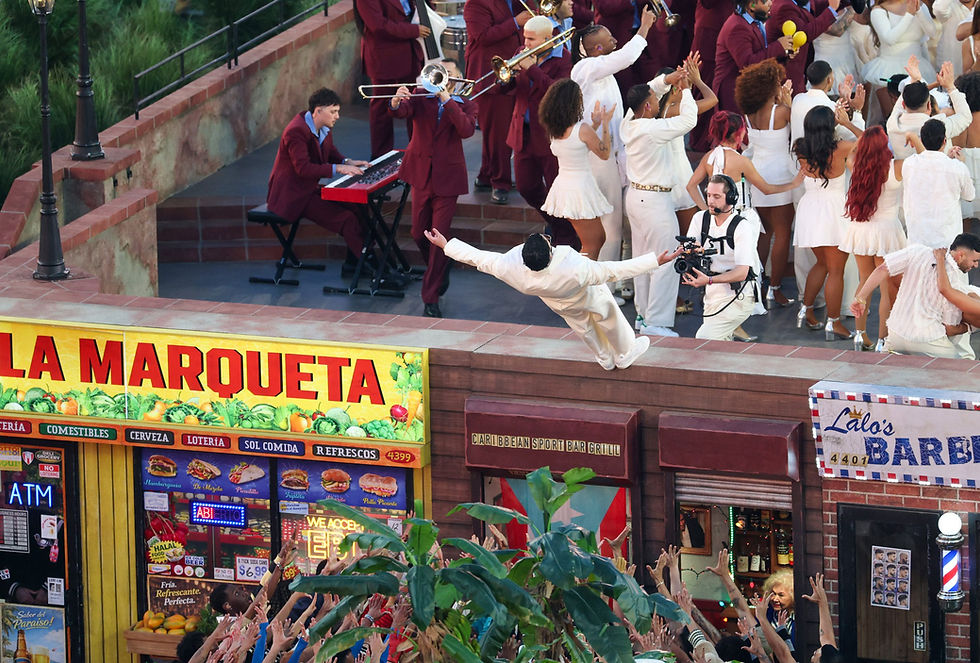
There was also a broader undercurrent running through the performance, one that many viewers immediately recognised. Beyond flags and language, the imagery gestured toward immigrant labour and migrant communities so often written out of the American story. Through references to food, work, land and cultural presence, Bad Bunny appeared to centre the very people America depends on while routinely marginalising. Those frequently reduced to political talking points, or dismissed outright, were instead framed as contributors. As foundations. These lives were not presented as peripheral. They were shown as integral. As the performance progressed, attention briefly turned toward forms of labour rarely acknowledged on stages like this: nail artists, farmers, everyday work placed not as metaphor but as presence. It reinforced the same idea threaded throughout the show: culture is built long before it is performed.
One of the most striking sequences came when dancers climbed utility poles, their bodies suspended above the field. The image was visually arresting, but its meaning ran deeper. It echoed the months Puerto Rico spent without electricity after Hurricane Maria, when communities were left waiting in the dark while aid was delayed under Donald Trump’s administration. The reference was not explained. It did not need to be. For those who lived it, the moment landed immediately. For others, it lingered.

As the performance drew to a close, the music stripped back into something percussive. The sugarcane remained underfoot as the ensemble moved forward together, flags already visible throughout the frame. Bad Bunny began the final sequence, emerging from the field, holding the Puerto Rican flag. As the music continued, he moved among, joining the ensemble and shifting from singing into speech. One by one, he named the countries of the Americas aloud. The cadence was steady and uninterrupted, the names stacking one after another until the word America no longer felt singular. The camera held its position, allowing the repetition to build rather than rush past.
Behind them, high above the field, the jumbotron remained lit with the words “The only thing more powerful than hate is love.” It stayed there throughout the final sequence. Fixed and unmistakable, in a stadium built for branding, sponsorship and spectacle, the message felt deliberately plain. Not a slogan designed to sell, but a line positioned to sit above everything else. It framed the moment without interrupting it, allowing the performance below to move while the sentiment stayed fixed.

As the list continued, the frame drew closer. The ensemble gathered around him, flags layered over one another, fabric crossing, colours colliding. When the list reached its end, he closed with, “and my motherland, mi patria, Puerto Rico.” At the centre of it all, Bad Bunny lifted an American football marked Together, We Are America, a silent but deliberate symbol of unity in a space built around competition and division. The group closed in around him. A brief stillness followed, just long enough for the message to settle. Then the tempo snapped back. ‘DtMF’ surged through Levi’s Stadium, the sound swelling as the crowd moved with it instinctively. The restraint lifted. Bad Bunny broke into motion, visibly energised, carried by the kind of unfiltered excitement that comes from knowing you’ve just done something that mattered.

His performance was not subtle, and it was not meant to be. In a climate that often rewards silence and neutrality, Bad Bunny chose clarity. There was a risk in refusing to perform in English. Risk in foregrounding political memory on a stage built for mass approval. Risk in trusting the audience to sit with meaning rather than be walked through it.
But that risk was precisely what gave the performance its weight. This was not a halftime show designed to be palatable. It was one designed to be honest. And in doing so, Bad Bunny reminded us that love, when rooted in heritage, care and conviction, is not soft. It is powerful.
Because love, when performed boldly, becomes resistance.


Comments